


Stories
Kenya
24 July 2026
Janvier’s path to agribusiness
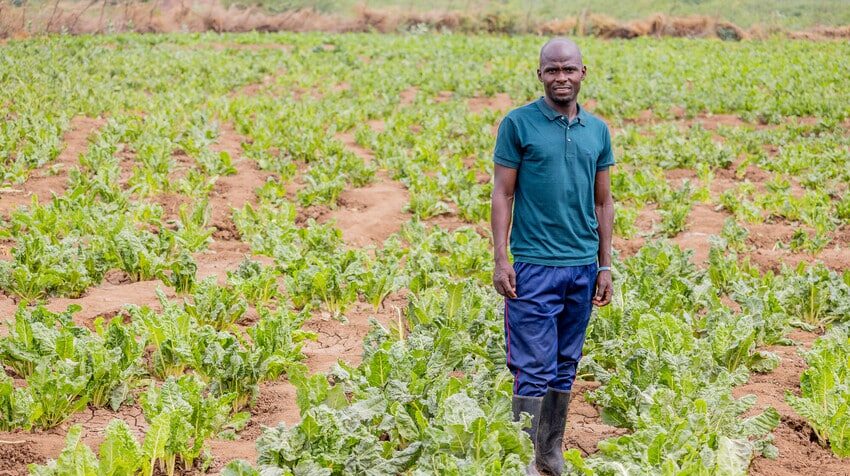
Farmer and entrepreneur Ombeni Janvier, who lives in the Kakuma Refugee Camp in northwestern Kenya, transformed a small vegetable farm into a thriving agribusiness through the DREEM programme, creating jobs, expanding his customer base and building a more secure future for his family.
When Ombeni Janvier arrived in Kakuma in 2017, he had little more than determination and a love for farming. A 29-year-old family man with a French-speaking education, Janvier faced numerous challenges, including language barriers and unemployment.
These are common issues for refugee-led enterprises, which face barriers such as limited finance, weak infrastructure, low literacy, inadequate technical training for young people and inconsistent regulatory information.
“Life was hard,” Janvier recalls. “I couldn’t apply for most jobs, so I decided to fall back on something I had always loved, farming.”

Ombeni Janvier picking his crops at his farm in Kakuma.
This is where through the Displaced and Refugee Youth Enabling Environment Mechanism (DREEM) programme, led by Farm Africa in partnership with the Mastercard Foundation and World University Service of Canada (WUSC), Janvier started his journey of becoming a successful agribusiness entrepreneur.
The DREEM programme worked with refugees and host communities to build resilient, market-driven livelihoods. It combined innovation grants with tailored business development services, including mentorship, capacity building and financial linkages.
These interventions aimed to enhance business performance, create dignified employment, promote sustainability and encourage diversification.

Ombeni Janvier with a digging hoe at his farm in Kakuma.
Janvier teamed up with four friends who shared his vision and together, they dug a shallow well and started cultivating vegetables on a small plot of land.
“I started with just 100 basins of crops,” Janvier says. “My revenue was around Ksh 15,000 a month and even that was unpredictable.” The turning point came when Janvier joined the programme and improved his farming skills.
“The DREEM programme provided me with pipes, a water storage tank and training on agribusiness. Before that, I was just farming for food. Now, I farm as a business and I am able to share the knowledge with other young people.”

Ombeni Janvier
Farmer and entrepreneur
One of the biggest changes was the new irrigation system, which replaced the manual watering method. “I used to rent pipes and pumps at 3,500 Kenyan shillings a week. It was unsustainable,” Janvier recalls. “Now, I save that money and water a larger area more efficiently.”
The programme also helped Janvier learn business management practices like recordkeeping and market analysis. “I keep track of every amount I invest in the business and what I make out of it. I have also expanded my customer base beyond the refugee camp. My dream is to supply all of Kakuma.”
With growth came job creation.

Ombeni Janvier’s crops.
“I employ eight people now, up from just three,” Janvier says. “We supported each other as friends. Now, each of us has our own farm.”
Despite the progress, challenges remain. “The shallow wells sometimes dry up, leaving my crops vulnerable,” Janvier explains. “And I don’t have secure land tenure. Sometimes multiple people claim the land I am farming on.”
Nevertheless, Janvier remains optimistic. “Don’t be afraid of farming. Today, farming is a business, not just a traditional activity,” he advises.
Janvier’s story is featured in our new report Nurturing growth in Kakuma and Kalobeyei.
Country
Kenya
Key focus areas
Boost youth employment
Increase incomes
Support businesses
Nurturing growth in Kakuma and Kalobeyei
Farm Africa’s DREEM project, delivered in partnership with WUSC and the Mastercard Foundation, empowered refugees and host communities in Kakuma and Kalobeyei, Kenya, by supporting 244 enterprises. Through training, mentorship and innovation grants, businesses grew resilient, created jobs and increased incomes. The programme shows how targeted support can transform livelihoods and foster economic independence in challenging contexts.
Download (2.96mb)

Country
Kenya
Key focus areas
Boost youth employment
Increase incomes
Support businesses

