
Expert view
Kenya
29 July 2026
Restoring soil, restoring livelihoods

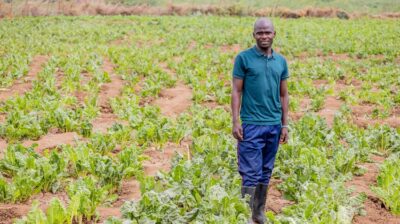
Perpetua Pius holding vegetables grown on her farm using regenerative farming methods in Embu County, Kenya.
Professor Jacqueline McGlade, Chief Scientific Officer at Downforce Technologies, writes about her company’s work with Farm Africa in Embu County, Kenya, assessing evidence of the impact of adopting regenerative agriculture practices on improving soil health.
Healthy soil is the foundation of resilient farming systems, productive landscapes and secure livelihoods. Yet across eastern Africa, decades of continuous cultivation, soil erosion and over‑reliance on chemical inputs have steadily degraded soil health, undermining farmers’ resilience to climate change and threatening food security.
In Kenya, a partnership between Farm Africa and Downforce Technologies is showing how combining regenerative agriculture with robust, scalable soil measurement can reverse this trend – and provide credible evidence of impact for farmers, funders and partners alike.

Modesto Kibuitu, a village-based advisor at his sorghum farm in Tharaka Nithi, Kenya.
How soil health can be measured
Soil is much more than a growing medium. Healthy soils store carbon, retain water, recycle nutrients, support biodiversity and underpin crop productivity. Central to these functions is soil organic carbon (SOC) – the carbon-rich organic matter derived from plant residues, roots and soil organisms.
Higher SOC levels are associated with improved soil structure, greater water holding capacity, increased nutrient availability and more active soil biology.
Historically, measuring SOC and soil health at scale has been difficult. Field sampling is costly, time-consuming and often impractical across tens of thousands of smallholder farmers’ plots. As a result, many regenerative agriculture programmes have struggled to generate the credible, landscape‑level evidence needed to demonstrate long‑term environmental and economic benefits.
What Downforce Technologies does
Downforce Technologies specialises in generating robust, scalable evidence of land‑use outcomes. By integrating satellite remote sensing, ground data and AI‑powered analytics, Downforce can measure and report annual changes in SOC across large and complex smallholder landscapes.
In Kenya, this approach enabled SOC to be tracked annually from 2017 onwards without the need for extensive new soil sampling. The resulting datasets provide:
- Consistent, repeatable SOC measurements over time
- Comparisons between programme participants and non‑supported farms
- Landscape‑level insights that support carbon accounting, programme evaluation and climate reporting
Crucially, this allows regenerative agriculture outcomes to be quantified credibly – at the scale required by institutional funders, corporate partners and emerging carbon finance mechanisms.
Working together in Kenya
In Kenya, one of Farm Africa’s flagship initiatives is the Strengthening Regenerative Agriculture in Kenya (STRAK) project, funded by the IKEA Foundation through AGRA. Through STRAK, Farm Africa has supported more than 50,000 farmers in Embu and Tharaka Nithi counties to adopt regenerative practices such as agroforestry, intercropping, crop rotation, mulching and the use of organic manure.

Silas Muchiri, a Village-Based Advisor in Embu County, Kenya, and his wife, pictured with green peppers they grow on their farm. The mulch they use on the plants can be seen in the photo.
To strengthen the evidence base for this work, Farm Africa partnered with Downforce to measure, monitor and verify changes in SOC across participating farms. The shared objective was clear: to demonstrate, with credible data, that regenerative agriculture is restoring soil health while delivering tangible economic and environmental returns for farmers.
Rising soil organic carbon
The results are compelling. Analysis of SOC trends across Embu and Tharaka Nithi counties revealed a consistent upward trajectory in SOC levels on farms supported by Farm Africa, compared to non‑supported farms and county‑wide averages.
Analysis shows a clear shift towards higher SOC concentrations during the life of the project, indicating that soil carbon stocks are steadily increasing under regenerative management.
These SOC gains sit alongside a separate body of soil health evidence from the same landscapes. Analysis of over 2,000 soil samples showed:
- Improved water infiltration from mulching‑based practices
- Increased soil organic matter through biomass transfer
- Early gains in soil biology, including large increases in nematode populations and arbuscular mycorrhizal fungi
Together, these indicators paint a coherent picture of soils that are becoming healthier, more resilient and more productive over time.
Country
Kenya
Key focus areas
Act on climate change
Boost productivity
Protect ecosystems
Farm Africa regenerative agriculture evidence in Embu and Tharaka Nithi counties
This presentation outlines the evidence of the impact of the use of regenerative agricultural practices on soil’s health, microbial diversity, organic carbon and fertility; crop yields; income streams and tree density on farms in Embu and Tharaka Nithi counties in Kenya. The practices were adopted by farmers participating in Farm Africa and AGRA’s regenerative agriculture project.
Download (1.93mb)

Country
Kenya
Key focus areas
Act on climate change
Boost productivity
Protect ecosystems
Lessons for scale‑up
The partnership between Farm Africa and Downforce demonstrates that regenerative agriculture can deliver measurable, verifiable improvements in soil health at scale – even across highly fragmented smallholder systems. Three wider lessons stand out:
- Evidence unlocks investment – Credible SOC data strengthens programme evaluation, fundraising and access to carbon finance initiatives such as agroforestry‑based schemes.
- Farmer‑led practices work – Adoption of locally appropriate regenerative practices drives both environmental and economic gains.
- Scalable measurement is essential – Remote sensing and AI make it feasible to monitor outcomes consistently across regions and over time.
As Farm Africa looks to scale regenerative approaches across eastern Africa and the Kenyan government looks to roll out a new national agroecology strategy we are optimistic that strong agronomy underpinned by strong evidence will lead to meaningful lasting change.
This article first appeared in Farm Africa’s 2025 Annual Review.
Country
Regional
Farm Africa Annual Review 2025
Our Annual Review includes inspiring examples of how our innovative programmes are championing methods of farming that don’t cost the Earth. Read about how:
- Farm Africa proudly marked our 40th anniversary in 2025, celebrating four decades of impact.
- Regenerative farming programmes are helping farmers to boost their productivity, build their resilience and restore ecosystems.
- Empowering rural women to become economically active is bringing benefits to whole families, communities and economies.
Download (2.28mb)

Country
Regional

