

Stories
Kenya
7 July 2026
How David shares knowledge to grow opportunity

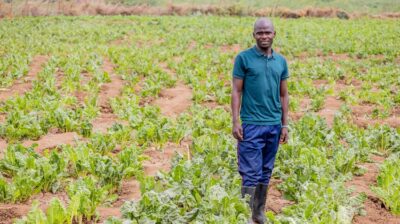
Farmer and Village-Based Advisor (VBA) David is helping build a more sustainable future in Embu County, Kenya. By advising more than 200 local farmers, he is strengthening climate resilience, improving livelihoods and conserving the environment for generations to come.
When David wakes up at 5.30 am each morning in Embu County, Kenya, his day begins with a prayer of thanks.
After breakfast of cassava or arrowroot grown on his farm, he heads outside to feed his chickens and rabbits before starting another busy day.
Through Farm Africa’s Strengthening Regenerative Agriculture in Kenya project, (STRAK), funded by the IKEA Foundation, through AGRA, he has learnt and adopted regenerative farming practices.
As both a farmer and a VBA, David divides his time between managing his own farm and supporting hundreds of other farmers in his community.

David practises mixed farming, growing crops, raising livestock and planting trees on his farm.
He grows maize, beans and vegetables (such as cassava and sweet potatoes), keeps chickens and raises fish. He also has a kitchen garden where he grows sukuma wiki and spinach.
With sukuma wiki being a popular, nutrient-dense vegetable, David sells it almost every day.
"My land helps me produce food for my family. The income from farming also helps me pay my children's school fees."

David Mwaniki
VBA
Like many farmers across Kenya, David has experienced the effects of climate change. Embu County faces increasingly unpredictable weather, making water conservation more important than ever.
To combat these climate effects, David has embraced regenerative farming practices that recycle nutrients from farming byproducts and help soil retain moisture.
Animal manure is used to fertilise crops and crop residues are turned into compost and returned to the soil. He also grows brachiaria grass, a type of nutritious and drought-tolerant fodder, for his goats.

David practising regenerative agricultural practices on his farm.
One innovation David is particularly passionate about is rearing Black Soldier Fly (BSF) larvae.
“BSF is rich in protein. We use it to supplement feed for fish, poultry and pigs,” explains David.
BSF larvae can be raised on kitchen waste and other organic materials, helping farmers reduce costs on commercial feeds, while using resources that would otherwise be discarded.
The idea is already spreading through David’s community. Several farmers have adopted BSF production and David regularly helps others establish their own systems.
“Just yesterday we were building a greenhouse for BSF for one farmer in the village,” he says.

David’s Black Soldier Fly (BSF) larvae.
To protect his farm from drought, David harvests rainwater during the wet season, collecting runoff from roads and rooftops and storing it for later use.
He also recycles nutrient-rich water from his fishpond to irrigate vegetables and other crops.
Alongside water harvesting, David is planting more trees and encouraging other farmers to do the same.
He also promotes good agricultural practices such as using certified seeds, crop rotation, mulching and microdosing fertiliser.
Because of these measures, David feels optimistic about the future.
“Personally, I’m not worried about climate change because I am putting measures in place to address it,” he says.

David harvesting water from his fish pond.
Two days every week, David leaves his own farm to visit farmers across the area. As a VBA, he works with around 210 farmers, sharing practical knowledge and helping them adopt more sustainable farming methods.
“Farm Africa has helped us a lot by training Village-based Advisors,” David says. “As I received the training for free, I use my free time to share it with other farmers.”
Through demonstrations on his own farm, David shows other community members how integrated farming systems can improve productivity and protect natural resources.
“Farmers can do a lot if they are facilitated with knowledge,” he says. “With the right knowledge, many people can farm sustainably.”
David believes expanding access to training could transform rural communities, creating jobs and improving livelihoods.
"If Farm Africa can continue supporting more Village-based Advisors, it can change agricultural systems in a very short time and people will have money in their pockets."
David Mwaniki
VBA
For David, farming is essential for creating opportunities, strengthening his community and building resilience for future generations.
“If agriculture goes wrong, nothing else gets a chance to grow,” he says. “Everyone depends on food produced by farmers.”
By sharing his knowledge and demonstrating what is possible, David is helping farmers across Embu County build a more sustainable future.
“Farming shouldn’t cost the Earth; it should provide income for my family and me.”

