


Stories
Tanzania
16 June 2026
Growing opportunities for the next generation

Smallholder farmer Judith Mbalaga raised four children through farming in Tanzania’s Dodoma region. But poor harvests and low incomes meant she could not afford schooling for them beyond primary school.
Today, she is helping to raise two grandchildren and is determined their future will be different.
"Before Farm Africa, I could not pay school fees, so my four children did not have an education. They just ended standard seven because I couldn't afford to pay for secondary school."
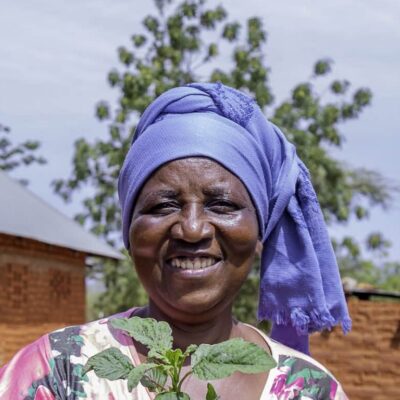
Judith Mbalaga
Smallholder farmer from Tanzania
Farming through uncertainty
Making a living from farming in Dodoma is increasingly challenging.
Even with long hours and hard work, farming remains vulnerable to increasingly unpredictable weather. Some years the rains fail altogether, leaving farmers with smaller harvests and less income.
“Last year there was no rain, so we did not harvest enough. Some households are facing food insecurity.”

Tanzanian farmer Judith tending to crops in her kitchen garden. Credit: Farm Africa/ Bertha Lutome
When harvests are poor, families have less food to eat and less income to cover essentials such as school fees, healthcare and household costs.
Alongside growing crops, Judith makes and sells doughnuts in her village to earn extra income.
“I earn a living from farming and other small businesses, like making doughnuts to sell to other people in the village. I get up at 4am to make them. My day finishes at 8.30-9pm.”
Growing more, earning more
Through the NOURISH project, funded by Norad and led by SNV in partnership with Farm Africa, Judith learnt how to grow sorghum using improved agricultural practices and drought-tolerant seed varieties that can better withstand dry conditions.
“Farm Africa has helped us to get improved seeds. So even when we face food insecurity, it’s not as much, because the seeds that Farm Africa provides are able to overcome the challenges of climate change.”
Judith Mbalaga
Smallholder farmer from Tanzania
The improved seeds, combined with better farming practices, have helped Judith increase her yields: “I farm sorghum, I plant at least five acres. I used to get about four bags an acre before my training with Farm Africa. Now I can get up to eight to ten bags an acre.”
Farm Africa has also helped connect Judith to reliable buyers, creating stronger markets for sorghum and helping her earn more from what she grows. She says, “I make at least two million Tanzanian shillings per year from just selling sorghum.”

Judith tending to crops in her kitchen garden. Credit: Farm Africa/ Bertha Lutome
Alongside farming, Judith also shares what she has learnt with other farmers. She explains, “First of all I’m a farmer, but I’m also a leader. What I do is bring other people in and train them.”
Building a better future
The additional income has enabled Judith to invest in her family’s future. The greatest change is what this stability now makes possible.
"Right now, because of the extra income, I'm able to take my grandchild, who is 16, to a better education. I also have another grandchild, who is starting standard one tomorrow."
Judith Mbalaga
Smallholder farmer from Tanzania
Farm Africa’s support has also helped Judith improve her family’s diet. Through the NOURISH project, Judith has learnt how to grow vegetables in a kitchen garden using water-saving techniques that allow crops to grow even during the dry season.
Judith says, “Before we used to eat dried vegetables during the dry season until the rain comes, but now we can get fresh vegetables every time. The vegetables feed the family and I sell anything extra. I use that income to buy meat or fish.”
Looking to the future
While Judith hopes to continue improving her farm, it is her family’s future that matters most. She says, “I would like to have my own farming tools in the future, that is my wish. But I want to see my family educated and they get good jobs.”

Judith sitting with her daughter and granddaughter. Credit: Farm Africa/ Bertha Lutome
As climate change continues to make farming more unpredictable, support that helps farmers adapt, increase their incomes and access reliable markets is more important than ever.
Judith’s story shows how the right support can help farming families build resilience while creating opportunities for the next generation.

