


Stories
Uganda
9 February 2026
Grace Arineitwe’s story

Grace Arineitwe is turning coffee farming into a source of progress for her family and community, producing higher-quality beans in Kanungu District in Uganda. She is also leading fellow farmers as chairperson of their Kayonza Coffee Growers’ Cooperative.
Coffee farmer Grace’s journey with Farm Africa began when she joined a cooperative.
For a long time, Grace worked hard but saw little return. In Kanungu, limited access to land, finance and reliable information on coffee production prevents young people and women from establishing successful coffee businesses.
In addition, poor agricultural practices lower product quality, forcing farmers to sell their coffee into low-grade markets, such as instant coffee.

Grace harvested coffee cherries all at once – ripe and unripe together – which lowered the quality of her coffee and the price buyers were willing to pay. She had also not received guidance on post-harvest handling.
“Before I got involved in Farm Africa’s project, I produced poor quality coffee because I used to strip all the cherries off the branch, regardless of whether they were ripe or not, causing cheaper prices and low earnings,”
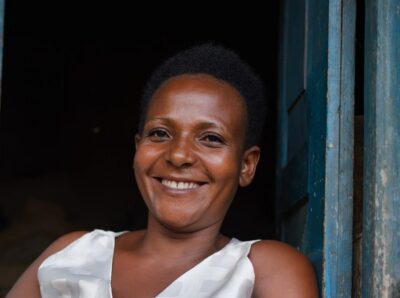
Grace Arineitwe
Coffee farmer and chairperson of their Kayonza Coffee Growers’ Cooperative in the Kanungu District in Uganda.
Once Grace joined the cooperative supported by Farm Africa, she began to learn the essential skills she needed to succeed.
Step by step, she was shown how to improve her coffee handling.
She now picks only ripe red coffee cherries and leaves the green cherries on the trees to ripen.
She uses farming techniques such as desuckering, stumping and pruning to keep her coffee trees healthy.

Grace and her coffee beans.

Grace feeding her birds.

Grace sorting her ripe coffee beans.

Grace's healthy, ripe coffee beans.

The Kanungu District in Uganda.

Grace tending to her coffee trees.

Grace with her healthy, ripe coffee beans.

Grace and her family.
She has also improved her post-harvest handling of coffee, drying coffee off the ground and storing it in a clean and dry environment to preserve its quality.
Alongside improvements in farming skills, Farm Africa’s support to the cooperative helps farmers market their coffee more effectively by connecting farmers with new buyers, encouraging bulk selling of coffee and setting up micro-washing stations, which add value to Arabica coffee varieties.
The project also strengthens collaboration and coordination among cooperative members.

Grace tending to her coffee trees.
Grace was introduced to a Village Savings and Loan Association (VSLA), giving her access to savings and small loans.
She began investing beyond coffee, using loans to start activities such as poultry and pig rearing, helping diversify her household income.
Putting these lessons into practice has changed her coffee farm.
Her coffee now commands higher prices, improving her family’s financial position. With more stable earnings, she can better support her children’s needs and plan ahead.
“Right now, I have many developments: my children attend school,”
Grace Arineitwe
Coffee farmer and chairperson of the Kayonza Coffee Growers’ Cooperative
Grace’s influence reaches beyond her own household. As chairperson of her cooperative, she encourages other coffee farmers to focus on quality and apply the skills she has learnt.
Looking ahead, she has clear ambitions.

Grace and her family.
“In the near future, I would like to be a big farmer, producing high-quality products, build a nice-looking house and see my children get a high-quality education,” she says. “Finally, I would like to drive myself and have a visit to the United Kingdom.”
With stronger technical knowledge, improved quality control and new income opportunities, Grace is using coffee farming as a foundation for long-term progress.
Grace took part in Farm Africa coffee projects funded by the European Union and UK aid from the UK government.
All photos: Farm Africa / Jjumba Martin

