

Expert view
Tanzania
30 March 2026
How energy self-sufficiency revolutionises farming

By Dr David Ojwang, Farm Africa Country Director for Tanzania
When we talk about food loss and waste, the conversation often centres on the end of the food chain: wasted surplus in supermarkets or leftovers scraped into household bins. But in many parts of the world, food is lost when farmers can’t efficiently store, process or transport what they’ve grown. Frequently, the cause is energy scarcity.
The energy gap
In Tanzania, only around 46% of people have reliable access to grid electricity. Living without power shapes almost every stage of smallholder farmers’ work.
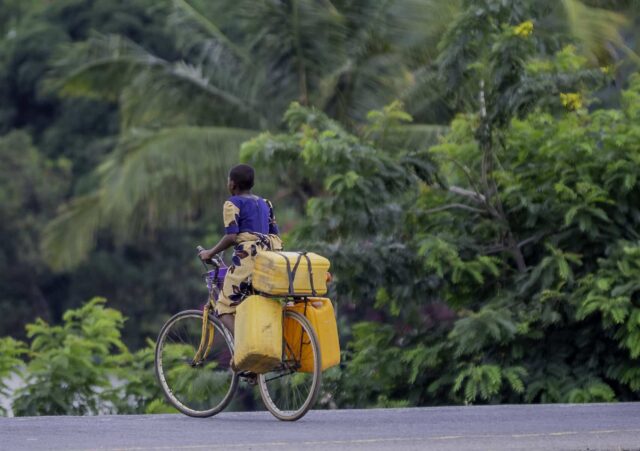
A woman rides a bicycle along a road in Tanzania. Credit: Farm Africa / Bertha Lutome
Without electricity to run irrigation systems, controlled storage facilities, processing machinery and transport vehicles, crops are at risk of drought, post-harvest processing like milling and oilseed pressing can’t be accomplished efficiently and produce spoils before it can reach markets.
The result is lost food, lost income and wasted effort.
Farmers often rely on petrol- or diesel-powered vehicles and generators to fill the energy gap, but these are costly, unreliable and contribute to carbon emissions. At home, many families use wood or charcoal for cooking, putting pressure on local forests and exposing women to harmful black carbon smoke.
Tackling energy scarcity is key to reducing food loss and increasing farmers’ incomes. And it can be done in a clean, green way.
Bridging the gap
That is the thinking behind the Powerfarm project, a pilot initiative in Kilosa District, Morogoro region, Tanzania, funded by Innovate UK and the UK and British High Commission Tanzania. Led by Aegis Energy and delivered in partnership with Farm Africa, EcoNomad, WAGA and KOC Bridges to Peace, the project is testing a simple but powerful idea:
By combining solar, wind and biogas energy, could farming communities produce enough energy to power electric vehicles and post-harvest machinery?

Ecomad biogas generator. Credit: Farm Africa / Bertha Lutome
At the centre of the pilot is an “EnergyHub” system integrating solar panels, wind turbines and an anaerobic digester to generate electricity.
By producing electricity as well as crops, farming households and their associated Agricultural Marketing Cooperative Society (AMCOS) can transform their operations.
With a reliable, off-grid solution for EV-charging, farmers can use electric vehicles to move farm produce from the field to collection centres, cutting expensive fuel and maintenance costs.
And with a reliable off-grid power source, post-harvest operations like milling and oilseed pressing can continue to run throughout grid electricity interruptions.
The system also makes use of something that would otherwise go to waste: agricultural by-products. Manure and crop residues feed the anaerobic digester, producing biogas that can be used to generate electricity or packaged and sold to households as cooking fuel, providing a healthier, smokeless alternative to firewood, charcoal or dung.
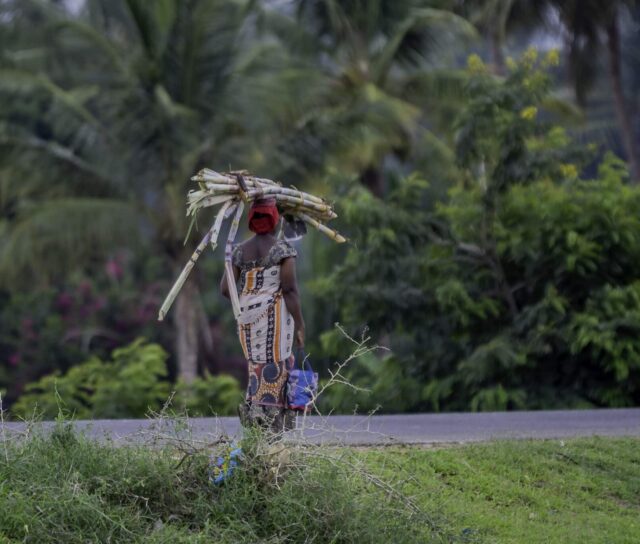
A woman walking with sugarcane balanced on her head. Photo credit: Farm Africa / Bertha Lutome
Beyond the technology, the Powerfarm model ensures communities can manage and benefit from these systems locally. For example, women and young people can receive training to assemble, maintain and operate renewable energy equipment, including small wind turbines.
This helps build a local green workforce, reducing dependence on outside engineers.
Farmer cooperatives are central to the model. By organising collectively, farmers can share equipment, aggregate produce and manage services such as processing and transport.
Reliable energy strengthens these AMCOS, allowing them to operate more efficiently and add value to the crops their members produce.
Collective energy
With Farm Africa’s extensive network of farming groups across Tanzania, it was easy to find a suitable AMCOS to host the pilot Powerfarm build.

Photo credit: Farm Africa / Bertha Lutome
HIMANA Agricultural Marketing Cooperative Society, located in Kilosa District, Morogoro region, provides post-harvest processing, storage and transport services for over 500 local paddy rice and sunflower farmers. In recent years, the group has worked to strengthen its capacity to meet rising demand for processing, but unreliable electricity results in hours of machinery downtime daily.
In 2025, the first phase of the Powerfarm build saw solar panels and small wind turbines installed, generating enough electricity to charge two electric vehicles for crop transport, making it the first multi-renewable off-grid EV charging station in Africa.
In March 2026, the anaerobic biodigester system became operational and was integrated with the solar and wind systems to form a unified energy system that now enables continuous operation of processing machines through grid interruptions, reducing electricity costs by about 25% at the same time.
These gains open new opportunities for the AMCOS to invest in upgrading facilities and diversifying services, including developing a valuable new income stream in the provision of e-mobility services.
Take a virtual tour of the Powerfarm

Scaling for global change
Projects like the Powerfarm show what energy self-sufficiency can look like in practice. By turning sunlight, wind and farm waste into reliable, renewable electricity, rural communities can reduce dependence on fossil fuels, improve the efficiency of food production and unlock new opportunities in the green economy.
With smallholder farmers producing an estimated 30% of the world’s food supply, that shift has the potential to revolutionise global food systems.